Launch offer — valid today only

📄 Digital book in PDF · read it on your phone or print it

Fire Officer I and Promotional Exam Prep, All in Drawings One Topic on Every Page

Incident command, divisions vs groups, span of control, the 5 construction types, size-up, the initial radio report, RECEO-VS, progressive discipline. Each topic gets its own page: the drawing first, then what you need to remember. 67 illustrated pages.

GET FIRE OFFICER I ILLUSTRATED

🔒 Secure checkout · PDF by email · 30-day guarantee

Every topic, its own pageEvery command structure, building type and tactic drawn, with the explanation right beside it
67 illustrated pages8 parts, from the officer's first day to exam day review
Up-to-date sourcesNFPA 1020 (formerly 1021) fire officer standard, FEMA NIMS/ICS and OSHA 29 CFR 1910.134
PDF by emailFormat

Look Inside the Book

Every page has one big drawing and a box with the numbers, rules and steps you need to know:

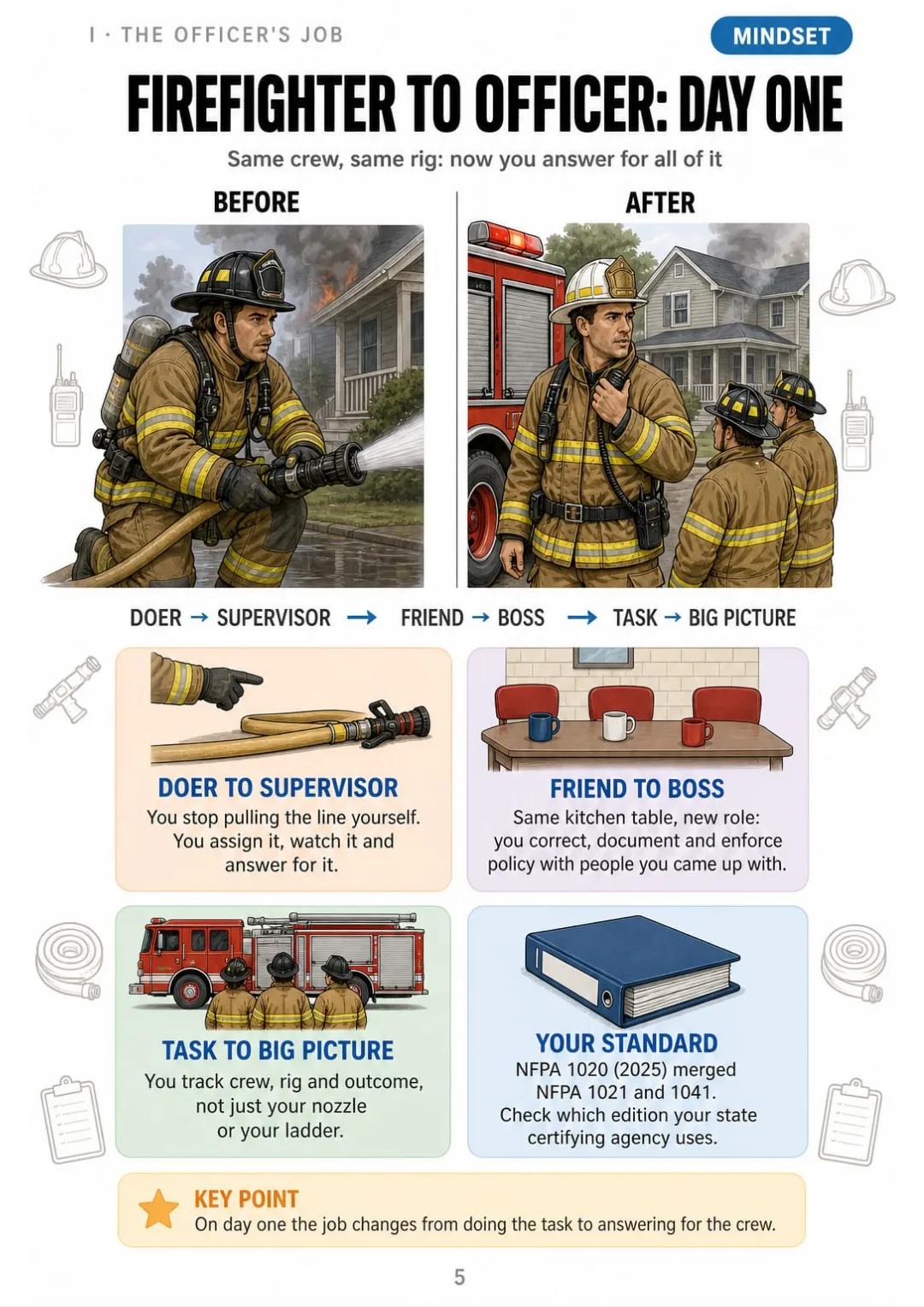
Three mindset shifts: doer to supervisor, friend to boss, task to big picture.
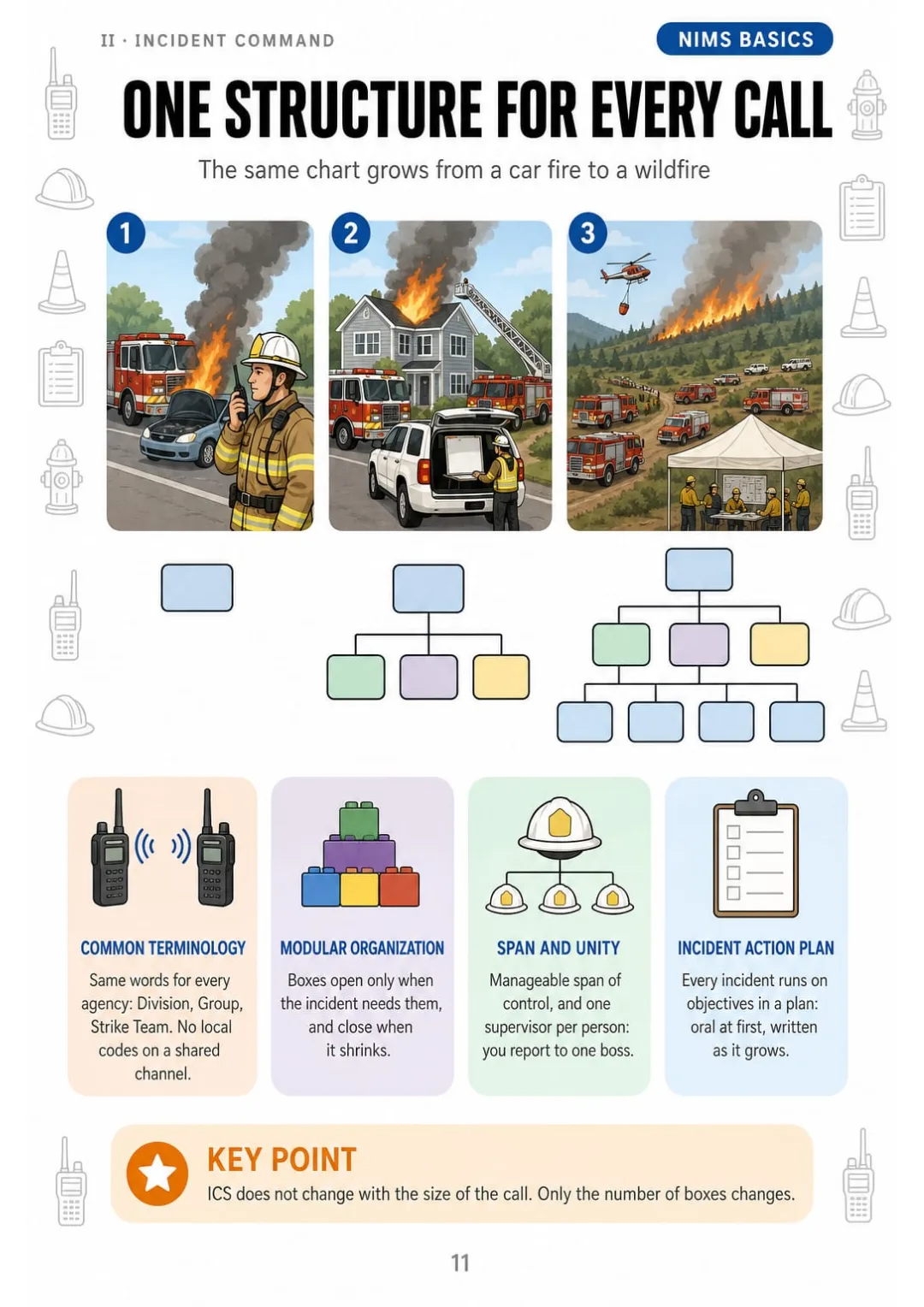
NIMS principles: common terminology, modular organization, span of control, unity of command, IAP.
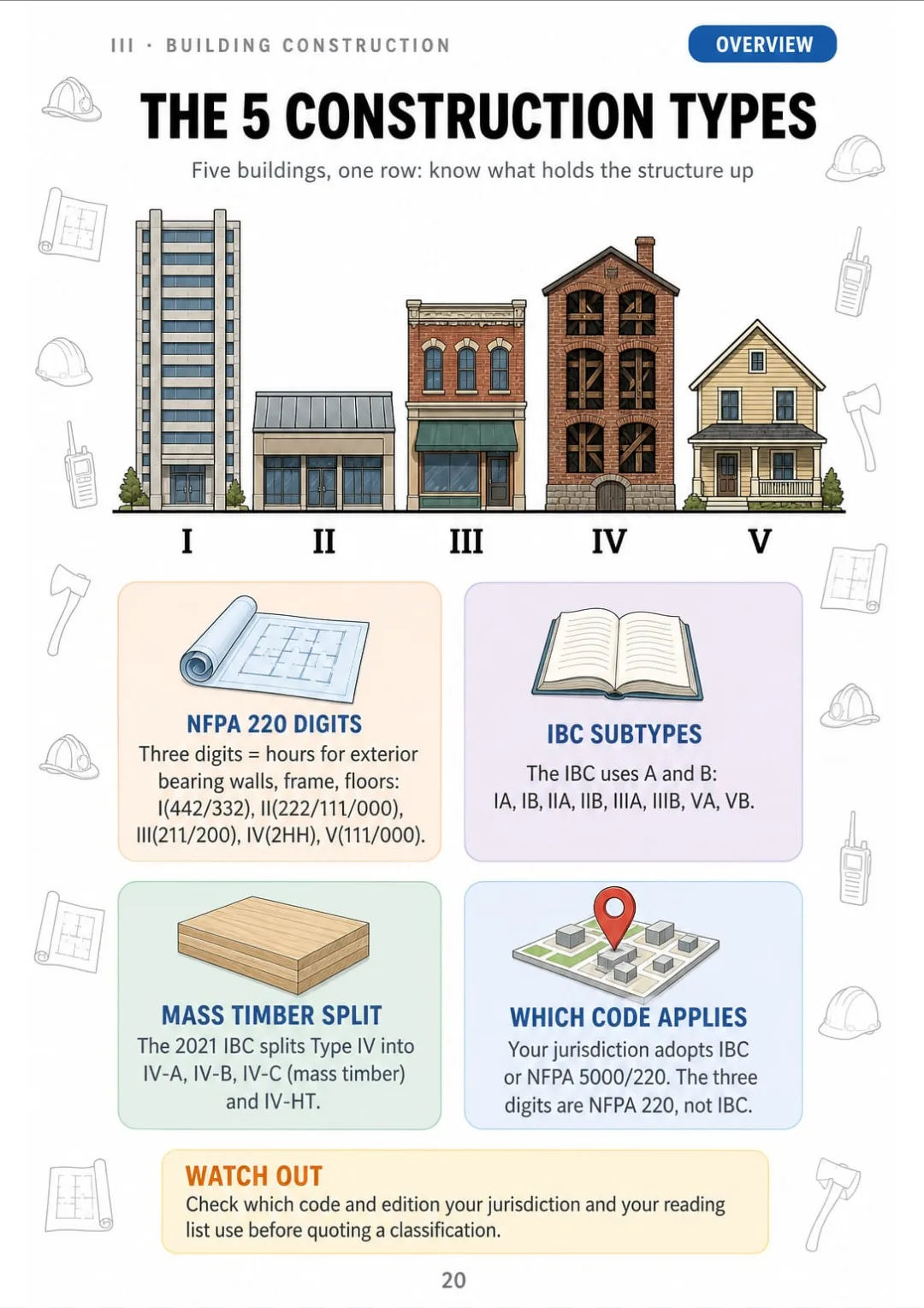
Types I to V drawn in one row, with NFPA 220 digits and IBC subtypes
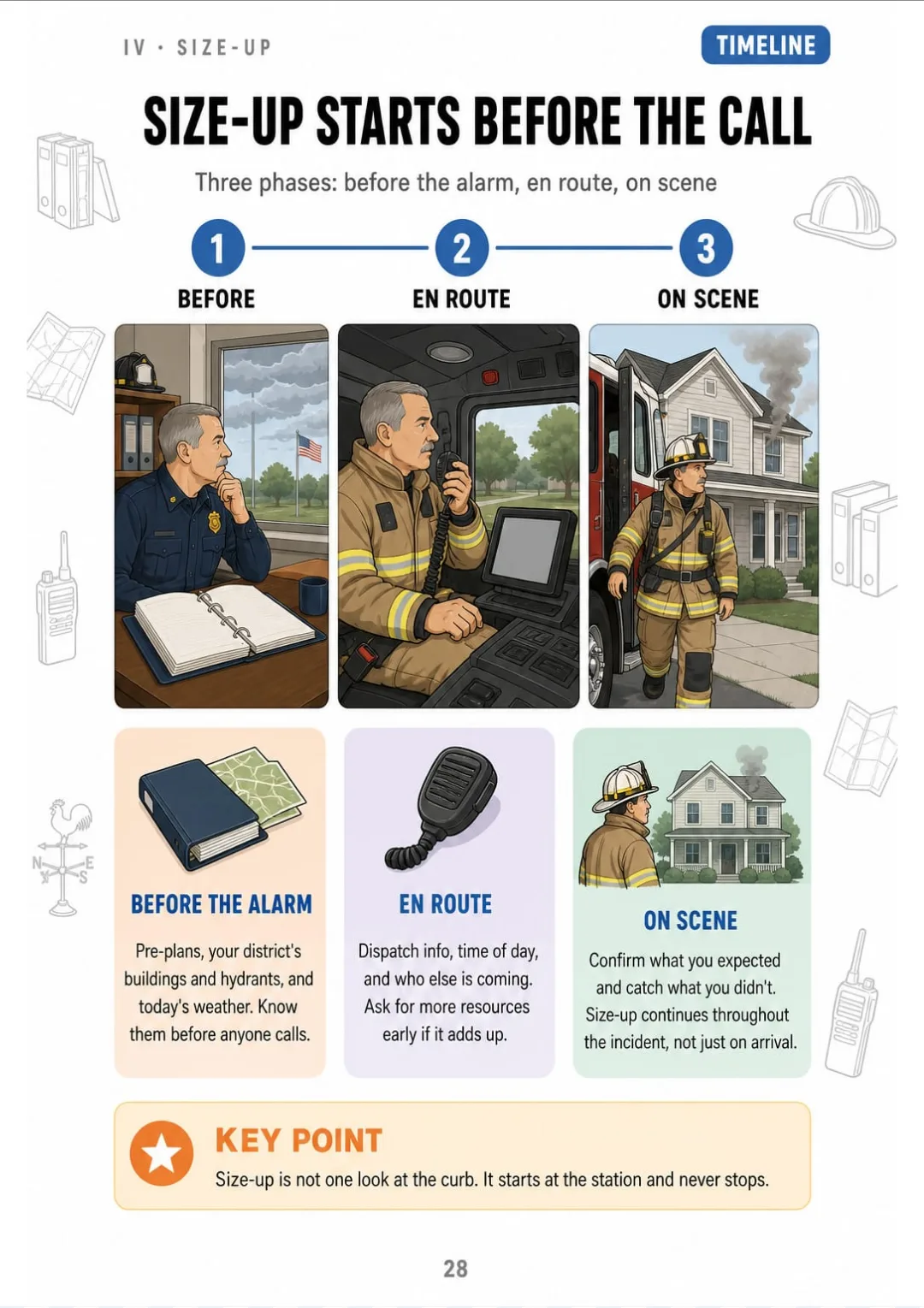
Size-up in three phases: before the alarm, en route, on scene, and it never stops
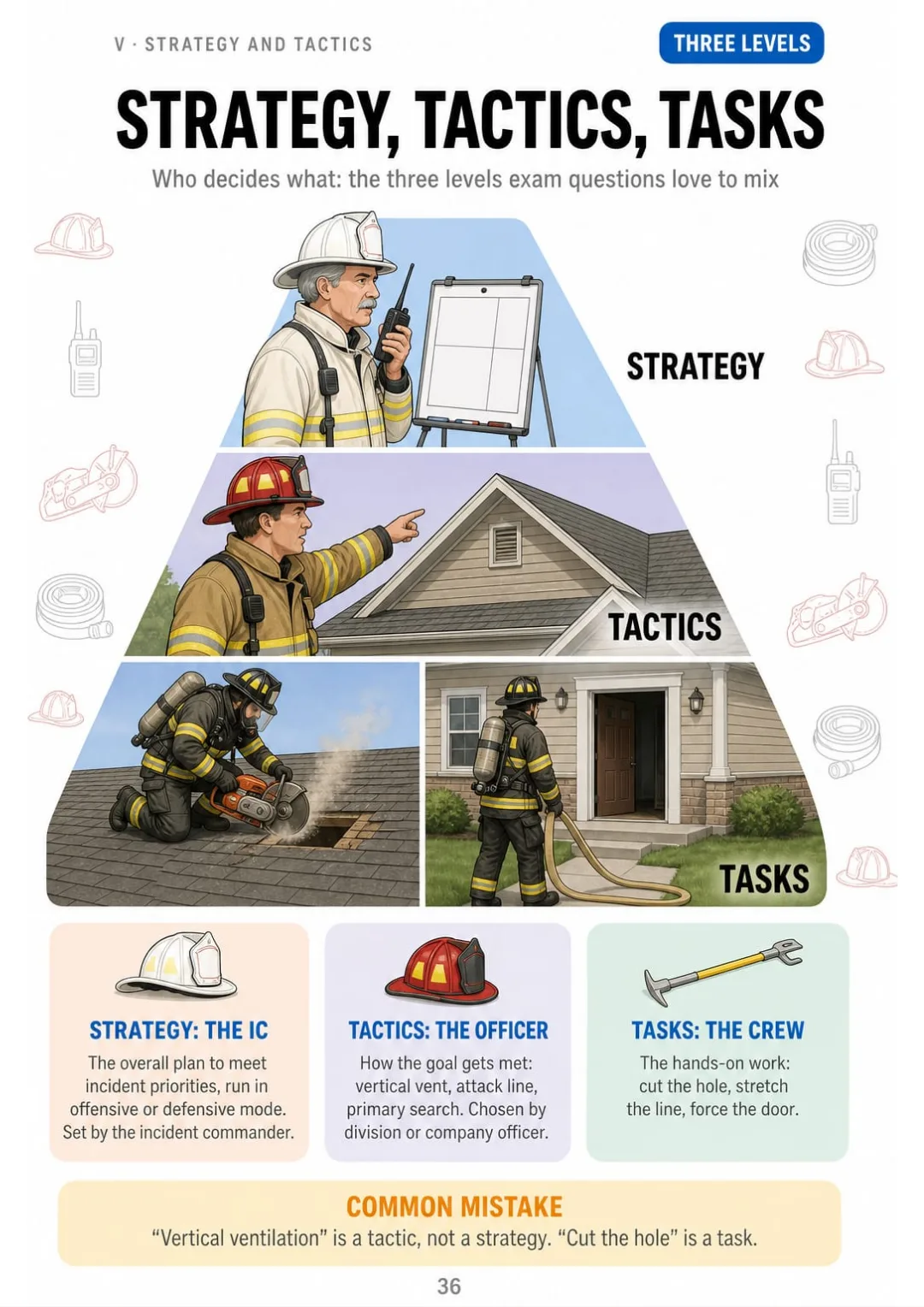
IC sets strategy, officers choose tactics, firefighters do tasks
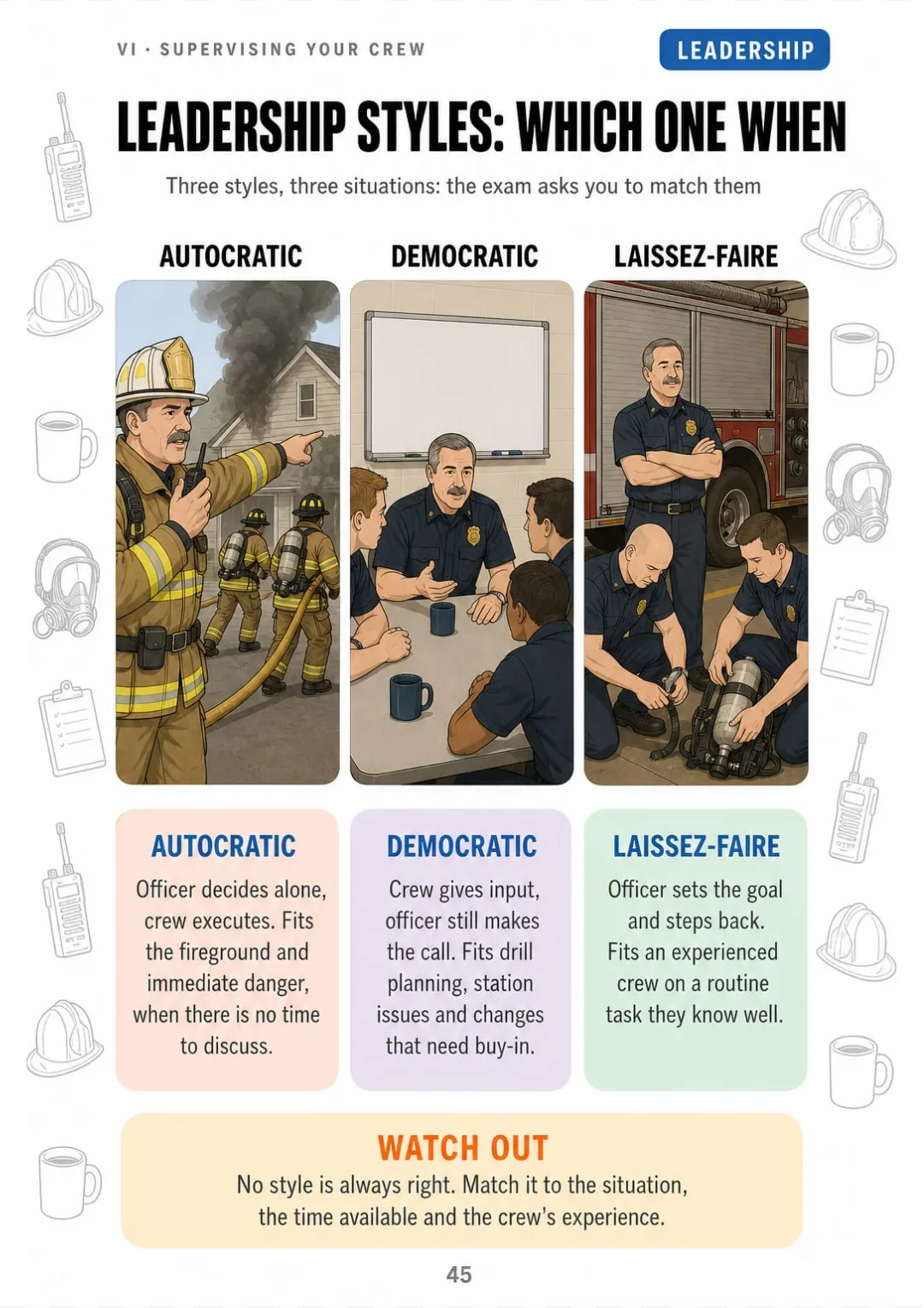
Autocratic, democratic, laissez-faire: each style drawn in the situation where it fits.
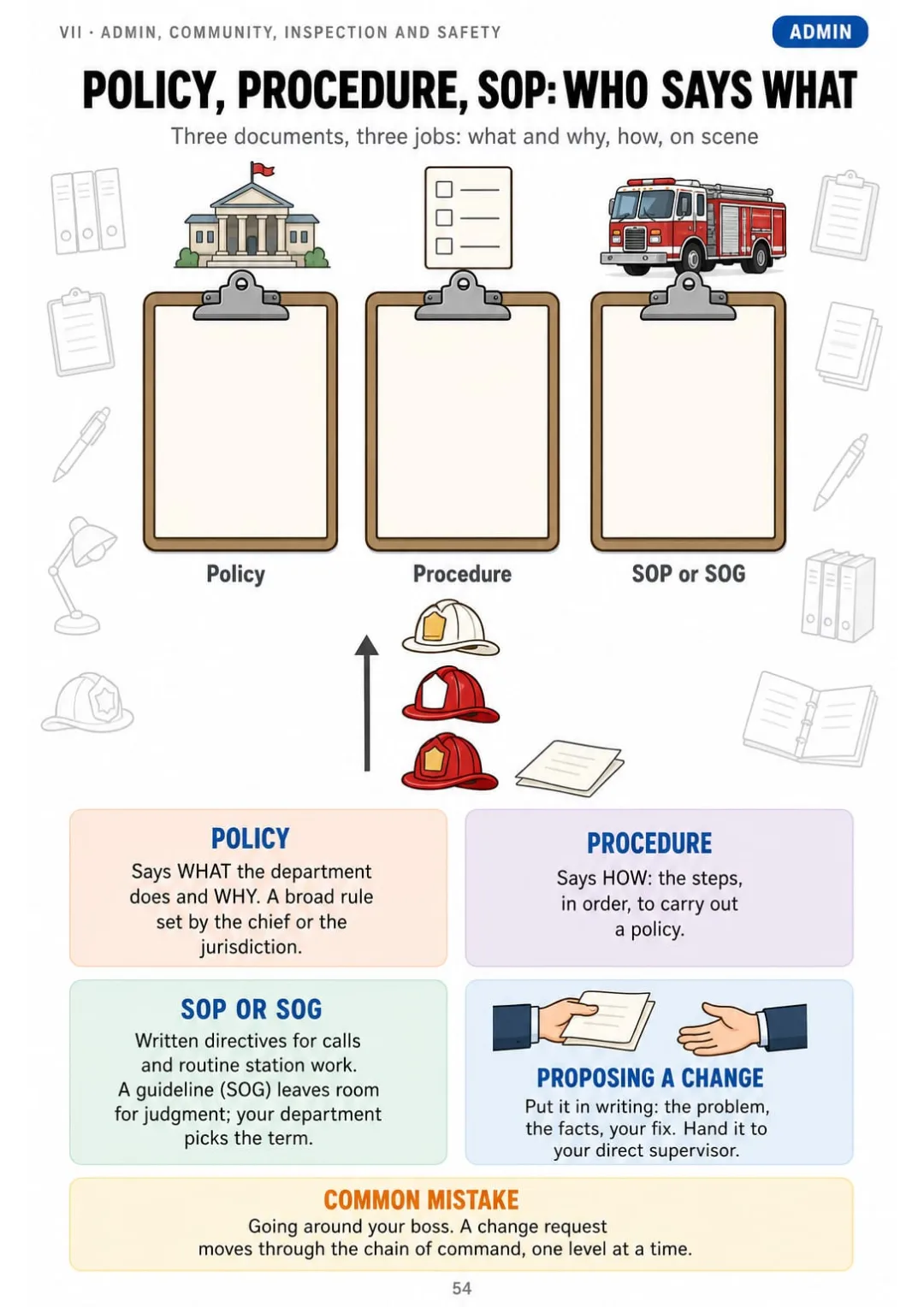
Policy = what and why · Procedure = how · SOP/SOG = the standard way, on calls and in the station
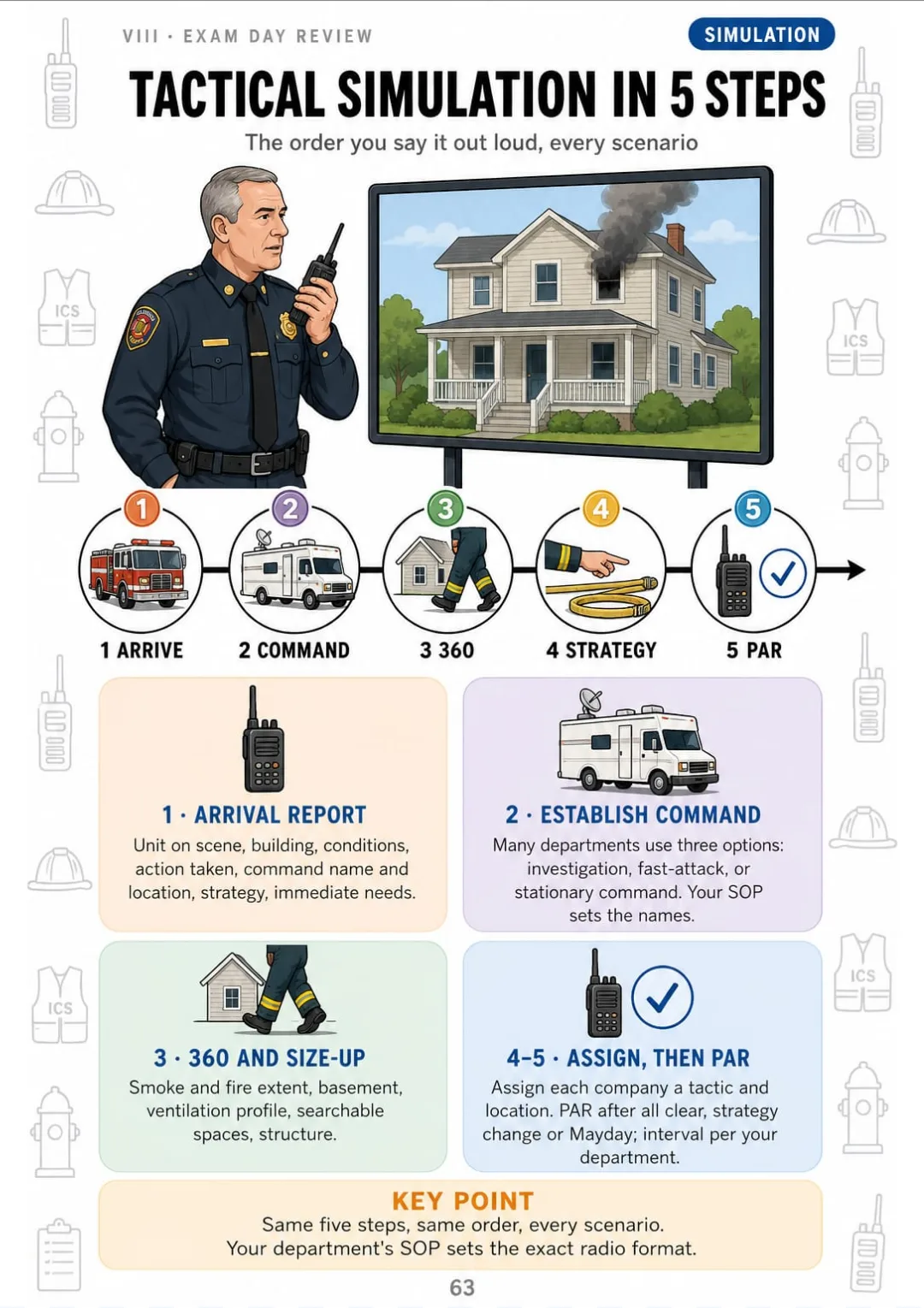
Arrive, command, 360, strategy, PAR: the tactical simulation as one timeline.

Swipe to see more →

These are real pages from the book. The table of contents is the full one: 8 parts and 63 topics.

The Problem Isn't You. It's How It Was Explained to You.

You're at the kitchen table with a practice question: brick walls, wood joists, fire in the cockloft. Type III or Type V? You've been inside a hundred of these buildings, and on paper you freeze.

The textbook spreads building construction over a whole chapter: fire-resistance ratings, wall assemblies, IBC subtypes, all in paragraphs. Nothing puts the five types side by side, so they blur together by the next shift.

Types I to V drawn in one row, with NFPA 220 digits and IBC subtypes

In this book, the five types share one page, in one row: Type I to Type V drawn next to each other, with the NFPA 220 digits and the IBC subtypes in a box. You see what's concrete, what's steel, what's brick and what's wood at a glance.

Same for divisions vs groups, span of control, the 13 size-up factors, RECEO-VS and the steps of progressive discipline: each one has its own page.

When the written exam or the oral board brings up a building type, you picture the page and answer in order, without going back to the textbook.

COMPARE FOR YOURSELF

The Same Topic, Two Ways to Study It

THIS
  • The textbook: line after line
  • NIMS principles explained only in words
  • You walk into the exam with doubts
The National Incident Management System establishes a standardized approach to incident management that is applicable across all jurisdictions and all hazards, regardless of the size or complexity of the incident. Among its foundational principles are the use of common terminology, whereby organizational functions, resources and facilities are designated consistently; a modular organization that expands or contracts according to incident requirements; the maintenance of a manageable span of control; adherence to unity of command, under which each individual reports to only one supervisor; and management by objectives as documented in the Incident Action Plan.
FOR THIS
  • The NIMS structure in one drawing
  • The principles in one box
  • You see it and you get it
NIMS principles: common terminology, modular organization, span of control, unity of command, IAP.
CONTENTS

Take a Look at the 8 Parts and 63 Topics

The company officer's job, incident command, building construction, size-up and the radio report, strategy and tactics, supervising your crew, admin and safety, and exam day review: 67 pages, all illustrated.

IThe Company Officer's Job · pp. 5-10
  1. From Firefighter to Officer: What Changes on Day One
  2. Fire Officer I vs Fire Officer II at a Glance
  3. The 6 Duty Areas of the Fire Officer I Standard
  4. How Promotional Exams Are Built
  5. Chain of Command and Unity of Command
  6. Authority, Responsibility and Accountability
IIIncident Command (NIMS/ICS) · pp. 11-19
  1. Why ICS Exists: The Same Structure on Every Call
  2. The ICS Org Chart as One Piece
  3. Divisions vs Groups: The Question Everybody Mixes Up
  4. Branches, Strike Teams and Task Forces
  5. Span of Control in Numbers
  6. Establishing Command: Three Options on Arrival
  7. Transfer of Command Step by Step
  8. Incident Action Plan and the ICS 201
  9. Accountability, PAR and Mayday (LUNAR)
IIIBuilding Construction · pp. 20-27
  1. The 5 Construction Types on One Page
  2. Type I Fire-Resistive: The Fire Stays Put, the Contents Don't
  3. Type II Noncombustible: Unprotected Steel
  4. Type III Ordinary: Brick Walls, Wood Inside
  5. Type IV Heavy Timber and Mass Timber
  6. Type V Wood Frame: Balloon vs Platform
  7. Lightweight Construction and Truss Roofs
  8. Collapse Warning Signs and Collapse Zones
IVSize-Up and the Radio Report · pp. 28-35
  1. Size-Up Starts Before the Call
  2. The 13 Size-Up Factors in the Same Order
  3. Sides and Floors: Labeling the Building
  4. Reading Smoke: Volume, Velocity, Density, Color
  5. Fire Behavior Today: Ventilation-Limited Fires
  6. The 360-Degree Walk-Around
  7. The Initial Radio Report, Line by Line
  8. Risk vs Benefit and the Rules of Engagement
VStrategy and Tactics · pp. 36-44
  1. Strategy, Tactics, Tasks: Three Levels
  2. Offensive, Defensive, Transitional: The Same House Three Times
  3. RECEO-VS: The Priority Order
  4. Incident Priorities: Life, Incident, Property
  5. Fire Flow: Two Formulas to Know
  6. Hoseline Selection and Placement
  7. Ventilation and Coordination With Attack
  8. Two-In/Two-Out and the RIT
  9. Overhaul, Salvage and Preserving the Scene
VISupervising Your Crew · pp. 45-53
  1. Leadership Styles and When to Use Each
  2. Motivation: What Actually Moves a Crew
  3. Delegation in 5 Steps
  4. Giving an Assignment Clearly
  5. Counseling a Firefighter: The Private Talk
  6. Progressive Discipline: The Steps in Order
  7. Documenting: Facts, Dates, Signatures
  8. Grievances and the Labor Contract
  9. Laws Every Officer Must Know
VIIAdmin, Community, Inspection and Safety · pp. 54-62
  1. Policies vs Procedures vs SOPs
  2. Reports and Records the Company Officer Owns
  3. Community Relations and Public Complaints
  4. Fire Inspections: The Walk-Through
  5. Occupancy Classifications
  6. Fire Cause: Securing the Scene and the Four Classifications
  7. Crew Health and Safety
  8. Pre-Incident Planning
  9. Post-Incident Analysis
VIIIExam Day Review · pp. 63-67
  1. The Tactical Simulation in 5 Steps
  2. The Oral Board: Structuring Your Answer
  3. The In-Basket Exercise: Sorting Priorities
  4. The Most Common Mix-Ups
  5. Final Checklist the Week Before

One Page, One Topic, All Clear

Think of it this way:

The assessor reads the scenario: a Type III building, smoke pushing from the eaves, you're first due with one crew. Then they stop and wait for your initial radio report.

In the book, you open the radio report page and see it drawn line by line: who you are, what you see, what you're doing, who has command. The same order every time you key the mic.

IC sets strategy, officers choose tactics, firefighters do tasks

Same for divisions vs groups, span of control, the 360, RECEO-VS and progressive discipline: each one on its own page, drawn.

Fire Officer I Illustrated is 8 parts and 63 topics, all drawn, ending with an exam day review: the tactical simulation, the oral board, the in-basket and a checklist for the week before.

What you see drawn, you don't have to memorize.

What's Inside Fire Officer I Illustrated:

Ipp. 5-10

The Company Officer's Job

What changes on day one, Fire Officer I vs II, the 6 duty areas, how promotional exams are built, chain of command, authority and accountability.

IIpp. 11-19

Incident Command (NIMS/ICS)

Incident command as one org chart you can redraw from memory: divisions vs groups, branches, strike teams vs task forces, span of control, establishing and transferring command, the IAP and ICS 201, PAR and Mayday.

IIIpp. 20-27

Building Construction

The 5 construction types on one page, Type I to Type V one by one, balloon vs platform frame, lightweight trusses, collapse signs and collapse zones.

IVpp. 28-35

Size-Up and the Radio Report

Size-up before the call, the 13 factors in order, sides and floors, reading smoke, ventilation-limited fires, the 360, the initial radio report, risk vs benefit.

Vpp. 36-44

Strategy and Tactics

Strategy, tactics and tasks, offensive, defensive and transitional, RECEO-VS, incident priorities, fire flow formulas, hoselines, ventilation, two-in/two-out and RIT, overhaul and salvage.

VIpp. 45-53

Supervising Your Crew

Leadership styles, motivation, delegation in 5 steps, clear assignments, counseling, progressive discipline, documentation, grievances and the laws every officer must know.

VIIpp. 54-62

Admin, Community, Inspection and Safety

Policies vs procedures vs SOPs, reports and records, community relations, inspections, occupancy classifications, fire cause, crew safety, pre-incident planning, post-incident analysis.

VIIIpp. 63-67

Exam Day Review

The tactical simulation in 5 steps, structuring an oral board answer, the in-basket, the most common mix-ups and a final checklist for the week before.

At the end of the book: Exam day review: the tactical simulation in 5 steps, the oral board, the in-basket and a final checklist.
Plus: 2 Free Books

BONUS 1Fire Officer I Practice Questions

BONUS 1: «Fire Officer I Practice Questions»

Value on its own: US$ 17.90

Practice with exam-style multiple-choice questions on every chapter, each answer explained and linked back to the page it comes from.

BONUS 215 Common Company Officer Mistakes + Quick-Review Cards

BONUS 2: «15 Common Company Officer Mistakes + Quick-Review Cards»

Value on its own: US$ 14.90

See the 15 most common mistakes side by side with the right way, plus one-page cards to review ICS, size-up and tactics before the exam.

Fire Officer I Illustrated with 2 Free Books

  • Fire Officer I Illustrated: 67 illustrated pagesUS$ 63
  • BONUS 1: Fire Officer I Practice QuestionsUS$ 17.90
  • BONUS 2: 15 Common Company Officer Mistakes + Quick-Review CardsUS$ 14.90
  • High-resolution PDF to printIncluded
Total value US$ 95.80
YOUR PRICE:
US$ 27
You save US$ 68.80
YES, I WANT FIRE OFFICER I ILLUSTRATED FOR US$ 27

📄 This is a digital PDF book sent to your email: nothing is printed or shipped.

Secure purchaseEncrypted payment30-day guarantee

PDF by email: We email you Fire Officer I Illustrated as a PDF, together with the two free books. It's a single payment: no installments, no extra charges.

Who This Book Is For

You're studying for Fire Officer I

You're studying for Fire Officer I

Each standard topic on its own drawn page, so a chapter you read between calls is still there next shift.

Your promotional exam is coming up

Your promotional exam is coming up

ICS, size-up, construction and tactics in the same order every time, plus an exam day review for the tactical sim, the oral board and the in-basket.

You're already an acting or new officer

You're already an acting or new officer

Counseling, the discipline steps and documentation drawn in the order you actually do them, to keep on hand at the station.

Everything You Get Today

US$ 95.80US$ 27
YES, I WANT FIRE OFFICER I ILLUSTRATED FOR US$ 27

📄 This is a digital PDF book sent to your email: nothing is printed or shipped.

30DAYS
GUARANTEE

30-Day Guarantee

Try Fire Officer I Illustrated for 30 days, bonus books included.

We refund everything if the file won't open, if the book isn't what you see here, if you were charged twice or if the email doesn't arrive. Just email us.

You pay once. No subscriptions.

Frequently Asked Questions

Is it for me if I have 15+ years on the job and have never sat for a promotional exam?

Yes. It doesn't teach you to fight fire: it puts the Fire Officer I material in order and in drawings, so you can explain what you already do the way the exam asks for it.

Where does the content come from?

From the current NFPA fire officer professional qualifications standard (formerly NFPA 1021, now consolidated into NFPA 1020), FEMA's NIMS/ICS doctrine and OSHA 29 CFR 1910.134 for two-in/two-out. Every standard reference is flagged so you can check it against the edition your department adopts.

Is it official material?

No. It's an independent illustrated study guide, not published or endorsed by NFPA, IFSAC, Pro Board, FEMA or any department, and it doesn't give you a certificate or CE hours. It doesn't replace your textbook; it sits next to it. The textbook spreads each topic over several pages. Here each topic gets one drawn page you can review between calls.

Does it replace my Fire Officer I course or my department's reading list?

No. Each department and state builds its own exam and reading list, usually on the NFPA Fire Officer job requirements. Before you buy, open the index on this page and compare it with your list. The book covers Fire Officer I. If your captain exam also lists Fire Officer II topics, like budgeting or multi-company command, you won't find them here. Your course and your reading list still come first.

Are the practice questions the ones on the exam?

No. They're written for this book, in the style of a multiple-choice exam, and each answer points back to the page it comes from. They are not official questions from any exam.

When and how do I get it?

The book and the 2 bonus books arrive as PDFs by email, at the address you enter at checkout.

Do I have to pay every month?

No. It's a one-time payment. No subscription.

Can I have it on paper?

Yes. It's a PDF you can print at home or at a print shop and keep at the station.

How does the refund work?

You have 30 days. We refund everything if the file won't open, if the book isn't what you see on this page, if you were charged twice or if the email doesn't arrive: just email us.

Before You Close This Page

No more rereading chapters that are gone by the next shift.

Divisions vs groups, you see them drawn and you've got it.

You walk into the exam knowing where everything is.

Drawings make studying faster.

The book is right below.

One-time payment: US$ 27 · Guarantee: 30 days · PDF by email

YES, I WANT FIRE OFFICER I ILLUSTRATED FOR US$ 27

📄 This is a digital PDF book sent to your email: nothing is printed or shipped.